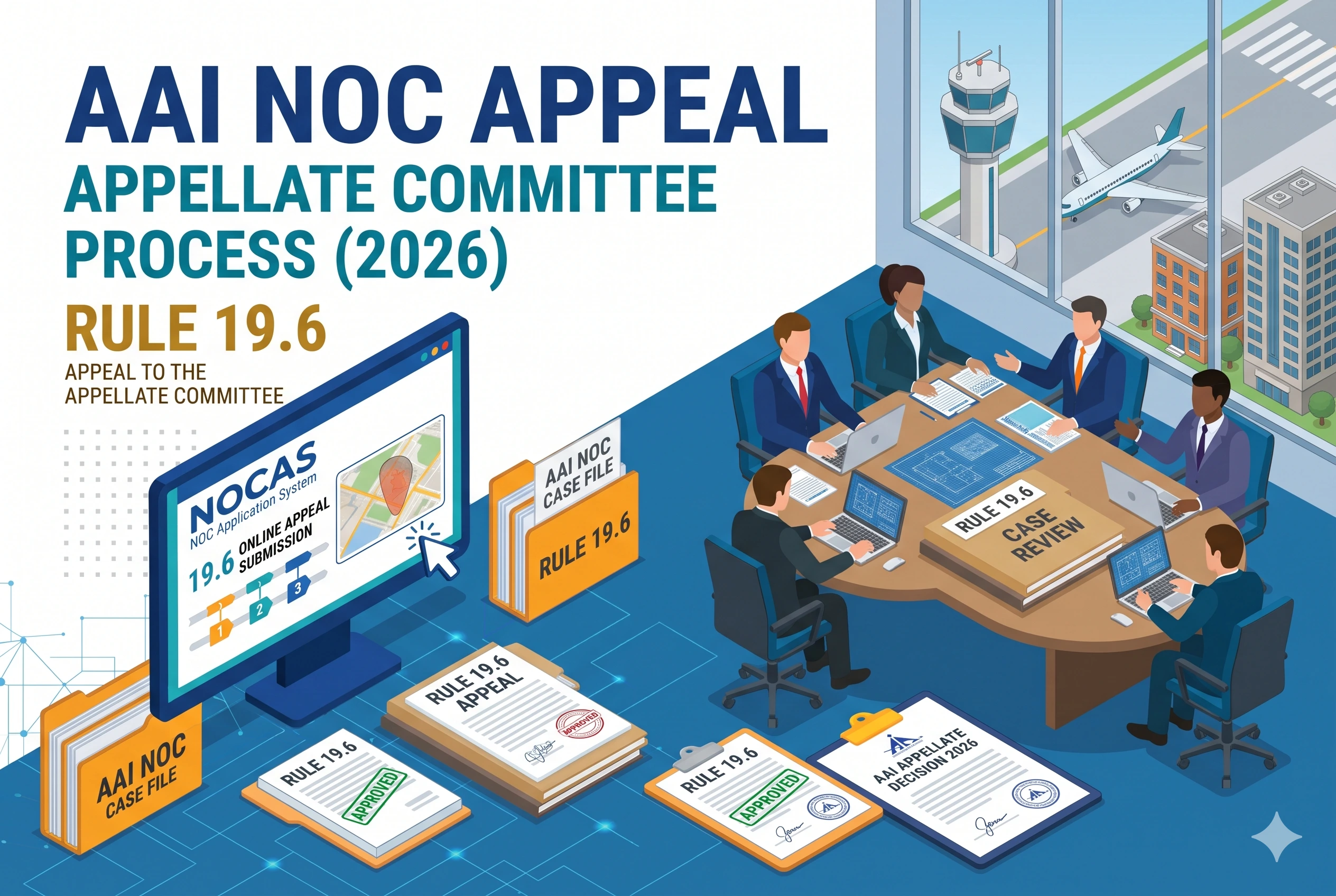
An AAI NOC appeal is a formal request to the Appellate Committee of the Ministry of Civil Aviation for a higher permissible height than the AAI Designated Officer granted. This guide explains who can appeal, the steps, the fees and the outcome. For quick fixes, read our AAI NOC objection reply guide.
Quick Answer
- The appeal goes to the Appellate Committee set up under Rule 11 of the Height Restrictions Rules, 2015 (GSR 751(E)).
- The fee is ₹2,00,000 plus GST, and the appeal must be filed within the NOC’s validity period.
- Committee approval is not the NOC. You still need to submit Undertaking 1E, after which a revised NOC is issued.
- A granted height cannot be reduced on review or appeal during the NOC’s validity.
What Is the Appellate Committee?
Rule 11 of GSR 751(E) creates the Appellate Committee. As notified, it has four members:
| Member | Role |
|---|---|
| Joint Secretary (Airports), Ministry of Civil Aviation | Chairperson |
| Joint Director General of Civil Aviation (Aerodrome), DGCA | Member |
| Member (Air Navigation Services), AAI | Member |
| One technical expert in communication or air traffic management | Member |
Appeal cases are received and processed by AAI’s corporate office at its headquarters in New Delhi. The committee decides only the height permissible under the Rules. It does not approve your building plan, land use or any other permission. For the legal background, see GSR 751(E) airport NOC rules.
Who Can File an Appeal?
Under Rule 11(2), any of the following who is aggrieved by a Designated Officer’s decision on permissible height:
- the applicant or developer;
- a local, municipal or town planning and development authority; or
- an airport operator.
Most appeals come from applicants, but the Rules are not limited to them. If someone files for you, attach the authorisation letter. Our what is AAI NOC guide explains who issues the NOC in the first place.
Review, Appeal or Fresh Application?
| Route | When it fits | Key points |
|---|---|---|
| Fresh application | AAI rejected on data or document errors | Correct and resubmit. See AAI NOC objection reply. |
| Review | You got less height than requested, or want more | Once only, to the Designated Officer, with Undertaking 1D |
| Appeal | You disagree with the height granted | To the Appellate Committee, with the ₹2 lakh fee |
| Writ petition | The process itself was unfair or unlawful | Through a High Court, with legal advice |
If the original rejection came from survey errors, fix those first. See wrong coordinates NOC rejected and airport NOC rejection reasons. An appeal that repeats a wrong survey will not help.
The Appeal Process, Step by Step
- Get a valid NOC first. An appeal challenges the height in an issued NOC. Check its validity date, because the appeal must be filed within that period.
- Prepare the case. Gather a corrected or fresh site elevation survey, a revised plan if needed, and the architect’s justification letter.
- Log in to NOCAS. Your dashboard lets you apply for review, revalidation and appeal. Our NOCAS portal application process shows the dashboard flow.
- File the appeal with fee and documents. Pay ₹2,00,000 plus GST and upload the documents listed below. The appeal is addressed to the Chairman, Appellate Committee.
- Wait for the committee. AAI’s headquarters processes the appeal, and the committee decides at its meetings. AAI has published committee minutes on NOCAS. We found no published decision deadline.
- Aeronautical or shielding study, if required. The committee may call for a study. Under AAI’s 2017 circular, this needs Undertaking 1E and a fee of ₹20,00,000 plus GST. Confirm the current amount on NOCAS.
- Receive the authorisation. If the committee approves, AAI issues an authorisation for revised height to the Designated Officer. In the case discussed below, the letter said plainly: “This is not an NOC.”
- Submit Undertaking 1E and get the revised NOC. Only the revised NOC from the Designated Officer lets you build to the new height.
Documents for an Appeal
| Document | Notes |
|---|---|
| Undertaking 1D | On ₹10 non-judicial stamp paper |
| Copy of the NOC | With its letter number and date |
| Architect’s justification letter | Must cite the State or local rules that make the requested height permissible |
| Location, elevation and layout plans | WGS-84 coordinates of all corners and buildings |
| Fee proof | ₹2,00,000 plus GST |
| Authorisation letter | If someone else files for the owner |
| Undertaking 1E | After approval, for the revised NOC |
For survey inputs, see the AMSL elevation certificate and WGS-84 coordinates certificate for NOC pages, plus our documents required for airport height clearance NOC guide.
Fees and Timeline
| Item | Amount or time |
|---|---|
| Application for the NOC | No fee |
| Appeal | ₹2,00,000 plus GST |
| Aeronautical study (if required) | ₹20,00,000 plus GST under the 2017 circular |
| Decision deadline | None published |
Real timelines vary a lot. In one reported Bombay High Court case, the committee met about seven weeks after the appeal was filed, but the formal authorisation letter followed many months later, after the aeronautical study. That is one case, not a norm. For the first-instance timeline, see the AAI NOC approval timeline.
What the Committee Can and Cannot Do
- It can approve a higher top elevation than the Designated Officer granted, with or without a study.
- It cannot reduce a height already granted, during the NOC’s validity.
- It does not replace municipal approval or other NOCs, and it does not decide defence matters. If your site is near a military airfield, see the defence NOC or AAI NOC flowchart.
What Makes an Appeal Stronger
- New technical facts: a corrected survey or revised design, not just an argument.
- A clear local-rule basis: the architect’s letter must cite the exact rule that makes the height permissible.
- Consistent numbers: survey, drawings and application should match. See the 5-minute checklist.
- Complete paperwork: missing details can cost years, as the case below shows.
- Realistic ask: a height tied to a genuine project need, such as FSI or rehabilitation units, is easier to justify than a round number.
No appeal is guaranteed. The committee decides on technical and safety grounds.
A Cautionary Case: Why Undertaking 1E Matters
In Paradigm Dotom Buildheights LLP v. AAI (Bombay High Court, 17 February 2025), developers in Mumbai won committee approval for a higher top elevation in 2015, and an authorisation letter followed in July 2016. They submitted Undertaking 1E, but AAI asked them to resubmit it because the signatory’s name and witnesses’ addresses were missing. That was never fixed in time. In 2023, AAI said the NOC had lapsed and the case must be reassessed under current rules.
The High Court called AAI’s position “too pedantic,” treated the omissions as a procedural lapse, and directed AAI to issue the NOC for the approved height. The lesson is practical: file a complete, correct Undertaking 1E as soon as the authorisation arrives. You can read the judgment on Indian Kanoon. The outcome turned on its own facts, so do not assume a court will rescue a late filing.
Mistakes to Avoid
- Filing after the NOC’s validity has expired
- Treating the committee’s approval as the NOC itself
- Building above your existing NOC while the appeal is pending
- Filing a second review, when only one is allowed
- Sending an architect’s letter that does not cite the rule
- Leaving Undertaking 1E incomplete or delayed
- Forgetting that structures such as mobile towers, solar projects and wind turbines have their own rules
If the Appeal Is Rejected
You can redesign to the height already granted, apply afresh if the facts have materially changed, or take legal advice about a writ petition under Article 226. Courts generally review whether the decision-making process was lawful and fair, not the technical height itself. In the Bombay case above, the court did not set a height, and it enforced the committee’s own earlier decision.
Related Guides and Local Support
Our guide to building height clearance AAI NOC shows how heights are set, and the CCZM explainer shows how zoning maps cap them. For city-specific work, see Mumbai, Delhi NCR, Pune and Ahmedabad. Our airport NOC survey services in India page covers the full range.
Frequently Asked Questions
What is an AAI NOC appeal?
It is a formal request to the Appellate Committee for a higher permissible height than the Designated Officer granted.
Who can file an AAI NOC appeal?
The applicant, a local or municipal planning authority, or an airport operator that is aggrieved by the Designated Officer’s decision on height.
What is the fee for an appeal?
₹2,00,000 plus GST. An aeronautical study, if required, carries a separate fee.
Until when can I appeal?
Within the NOC’s validity period. The NOC is valid for 8 years and can be extended to a maximum of 12 years from issue under Rule 9A.
Can the committee reduce my granted height?
No. A height already granted cannot be reduced on review or appeal during the NOC’s validity.
Is Appellate Committee approval the same as an NOC?
No. The committee authorises a revised height. You then submit Undertaking 1E and receive the revised NOC from the Designated Officer.
Can I keep building while the appeal is pending?
Only up to the height in your existing NOC. Do not go above it until the revised NOC is issued.
Can I go to court?
You can file a writ petition in a High Court, and courts have reviewed Appellate Committee decisions. Outcomes depend on the facts, so take legal advice.
Need Help Preparing an Appeal?
Share your NOC letter and the height you need, and our team will check the survey data and prepare the documents. Visit Surveying India or contact us. Verify current forms and fees on NOCAS and the Ministry of Civil Aviation website.
Last updated: 30 October 2026. This guide is informational and is not legal advice. We do not decide appeals, and we cannot guarantee any outcome.