
What is GSR 751(E)? Complete Guide to Airport NOC Rules in India
[IMAGE SUGGESTION 1: Featured image — an aircraft on final approach over a city skyline with a building height clearance overlay graphic. Alt text: “GSR 751(E) airport NOC rules explained — height restriction zones around Indian airports”]
Are you building anything taller than a single-storey structure within 20–56 km of an Indian airport? If so, you have probably run into one confusing term again and again: GSR 751(E). It shows up in municipal rejection letters. It appears in AAI correspondence. It even shows up in every airport NOC survey report. Yet almost nobody explains it in plain language.
In short: GSR 751(E) is the Government of India notification, issued by the Ministry of Civil Aviation on 30 September 2015, that makes an Airport NOC mandatory before you construct any building, tower, chimney, transmission line, or tall structure near a civil or defence aerodrome. The rule protects the airspace that aircraft need for safe take-off, landing, and navigation.
This guide breaks down GSR 751(E) airport NOC rules in detail. You will learn what the law actually says, who it applies to, how the NOC radius works, what documents you need, and what happens if you skip it. So, whether you are a developer, a telecom company, a solar or wind energy project owner, or a homeowner adding a floor, this is the complete reference you need before you touch a shovel.
What is GSR 751(E)?
GSR 751(E) is the short name for the Ministry of Civil Aviation (Height Restrictions for Safeguarding of Aircraft Operations) Rules, 2015. The Ministry of Civil Aviation notified this rule in the Gazette of India as G.S.R. 751(E) on 30th September 2015. It replaced an earlier, less detailed notification, SO 84(E) of 2010, and it remains the primary legal instrument governing height clearance around Indian airports today. For the full statutory background, you can also check AAI’s official NOCAS FAQ page.
At its core, GSR 751(E) does three things:
- It defines the geographic zones around every civil aerodrome in India where construction height stays legally restricted.
- It makes an Airport NOC (height clearance) mandatory before any construction, extension, or tree plantation begins within those zones.
- It gives the Airports Authority of India (AAI) authority to process, approve, or reject NOC applications through a dedicated online system — the NOC Application System (NOCAS).
In simple terms: if GSR 751(E) applies to your site, you cannot legally start construction until AAI issues an NOC. This holds true regardless of what your municipal building permit says.
Why Was GSR 751(E) Introduced?
Aircraft need clear, obstruction-free airspace around every runway to take off, land, and navigate safely. Internationally, ICAO Annex 14 — Aerodromes defines this protected zone as the Obstacle Limitation Surface (OLS). However, before GSR 751(E), India enforced height control around its airports inconsistently. As a result, unplanned high-rise construction, telecom towers, and even tall trees kept encroaching on this protected airspace.
To fix this gap, GSR 751(E) formalised a uniform, nationwide system. Now:
- Every civil and licensed private aerodrome in India has a legally defined safeguarding zone.
- Local municipal and development authorities must check with AAI before approving tall structures.
- Authorities can penalise violations — including through demolition — regardless of any local building sanction already granted.
Who Does GSR 751(E) Apply To?
GSR 751(E) applies to construction and vertical development around every civil aerodrome listed in Schedule III of the notification. This includes AAI-operated airports, licensed state government aerodromes, and private aerodromes that handle civil commercial flights. The rule also extends, through a separate procedure, to sites near defence aerodromes operated by the IAF, Army, and Navy.
Importantly, the rule applies no matter who is building or what the structure is for. In practice, GSR 751(E) airport NOC compliance is relevant to:
- Real estate developers and builders constructing residential or commercial towers
- Individual property owners adding floors to an existing house
- Telecom companies erecting mobile towers or OFC infrastructure
- Power utilities building solar power project structures or wind turbines and windmills
- Industrial units with chimneys, cooling towers, or flare stacks
- Advertisers erecting large hoardings and billboards near flight paths
- Contractors operating tower cranes during construction
So, if your project sits within the safeguarding radius of any airport, civil or defence, GSR 751(E) applies to you.
NOC Radius Under GSR 751(E): VFR vs IFR Airports
[IMAGE SUGGESTION 2: Simple diagram showing concentric circles around an airport — 20km VFR ring and 56km IFR ring, with the Aerodrome Reference Point (ARP) marked at the centre. Alt text: “GSR 751(E) NOC radius map — 20km VFR and 56km IFR zones around Indian airports”]
One of the most searched questions about this rule is simple: how far from an airport does GSR 751(E) actually apply? The answer depends on the type of aerodrome, measured from its Aerodrome Reference Point (ARP):
| Airport Type | NOC Radius from ARP | Examples |
|---|---|---|
| IFR aerodrome (Instrument Flight Rules) | Up to 56 km | Delhi (IGI), Mumbai, Bengaluru, Hyderabad, Chennai and other major airports |
| VFR aerodrome (Visual Flight Rules) | Up to 20 km | Smaller domestic airports, flying clubs, select state airstrips |
| Defence aerodrome | Case-specific, assessed separately | IAF, Army, and Navy airfields |
Within this radius, permissible height is not flat. Instead, it decreases the closer you get to the runway, following the Obstacle Limitation Surface model. In fact, there is an outright no-construction zone extending roughly 500 metres around the runway strip itself. This is exactly what an Airport NOC survey and site elevation report is designed to establish for your specific site.
What Structures Need an NOC Under GSR 751(E)?
GSR 751(E) does not only cover buildings. Any structure that could project into protected airspace needs clearance, including:
- Buildings and residential towers — including additional floors on an existing structure (building height clearance guidance)
- Telecom and broadcast towers — mobile towers, TV/radio masts, OFC poles above the threshold height
- Industrial chimneys and stacks — factory chimneys, cooling towers, flare stacks
- Power and energy infrastructure — transmission towers, wind turbines, solar farm structures
- Cranes — tower cranes operating above permissible height during construction
- Hoardings and billboards — large outdoor advertising structures near flight paths
That said, not every structure needs an NOC. If your site sits beyond the applicable radius, or if the proposed height stays within the elevation permitted on AAI’s zoning map, you may not need formal clearance. Even so, always confirm this in writing rather than assuming it.
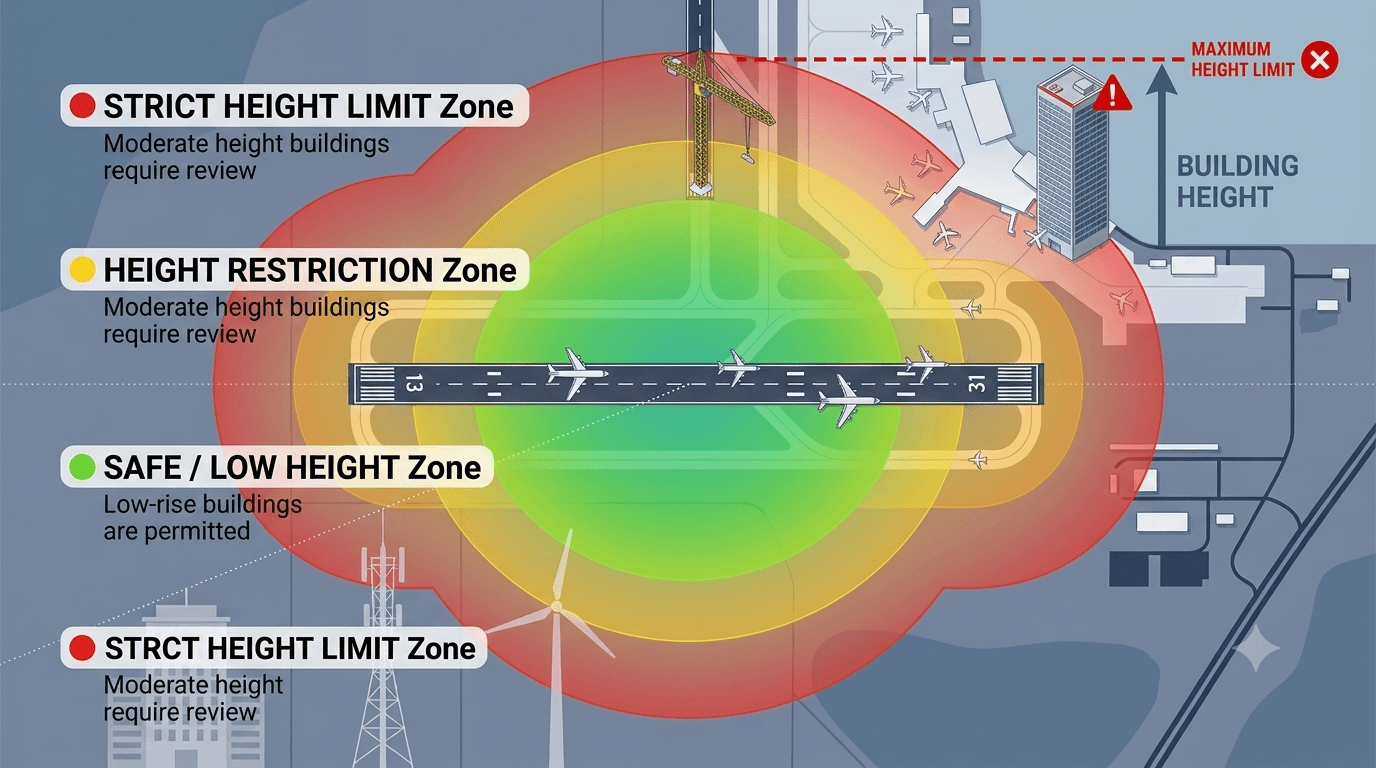
Understanding the Colour Coded Zoning Map (CCZM)
For select cities, AAI has published a Colour Coded Zoning Map (CCZM). This map divides the area around an airport into zones based on permissible construction height. Where a CCZM exists, local municipal bodies can approve construction directly, without referring the case to AAI, as long as the Requested Top Elevation (RTE) stays below the Permissible Top Elevation (PTE) shown on the map.
| Zone | Meaning | What It Means for You |
|---|---|---|
| Green | Height is well below the permissible elevation | NOC generally not required, subject to confirmation |
| Yellow | Height is close to or borderline with the limit | NOC application required; outcome depends on precise survey data |
| Red | Height exceeds the permissible elevation | NOC likely restricted or rejected at the proposed height; reduction may be needed |
Zone boundaries rely on exact coordinates and ground elevation. Therefore, even a small survey error can shift a site from “green” to “yellow” on paper. This is why certified GPS and AMSL data matter so much at the application stage.
How to Apply for NOC Under GSR 751(E): The NOCAS Process
You file all applications under GSR 751(E) online through AAI’s NOC Application System (NOCAS). The typical process looks like this:
- Site feasibility check — confirm the airport type (VFR/IFR), distance from the ARP, and whether a CCZM applies to your site.
- Survey and data capture — certified GPS coordinates (WGS-84) and AMSL elevation, gathered through RTK-GNSS survey equipment.
- OLS analysis — proposed structure height checked against the Obstacle Limitation Surface for that specific airport.
- Documentation — elevation certificate, coordinate certificate, site plan, and declaration prepared in AAI’s required format (full documentation checklist here).
- NOCAS filing — application submitted online and tracked through AAI’s regional NOC cell.
- Approval and compliance — once granted, you receive guidance on obstruction lighting, day-marking, and NOC validity period.
Generally, NOCAS scrutiny takes 30–60 days. However, inaccurate coordinate data remains the single biggest reason applications get delayed or rejected on first submission.
Documents Required for NOC Application
- Certified GPS coordinates in WGS-84 format
- AMSL (Above Mean Sea Level) site elevation certificate, signed by a licensed surveyor
- Structural drawings showing proposed height, floor plans, and elevation views
- Site plan with surrounding context and access details
- Land ownership documents or lease deed
- Authorization letter, if the applicant is not the registered owner
- Signed NOCAS declaration undertaking compliance
- Applicable fee payment confirmation
Penalties for Non-Compliance with GSR 751(E)
Building without a required NOC carries real, enforceable risk — not just a paperwork problem. Under GSR 751(E), authorities can order demolition or height reduction for any structure or tree that infringes on an airport’s Obstacle Limitation Surface without clearance. This holds true independent of any local municipal building permit you already obtained. Why? Because a municipal sanction and an Airport NOC come from two entirely different authorities, assessed against two entirely different criteria. One does not substitute for the other.
Enforcement got stronger with the Aircraft (Demolition of Obstructions caused by Buildings and Trees) Rules, 2023, notified by the Ministry of Civil Aviation. These rules give authorities explicit power to start demolition proceedings and impose penalties under the Aircraft Rules for unauthorised structures that encroach on safeguarded airspace.
GSR 751(E) NOC for Defence Airports
Structures near Air Force, Army, or Navy aerodromes follow a related but separate track under GSR 751(E). Instead of AAI’s civil NOCAS system, the concerned Ministry of Defence authority coordinates clearance, and documentation requirements can differ in scope and sensitivity. So, if your site falls near a defence airfield, it is worth reviewing our detailed guide on defence and IAF height clearance NOC requirements before you begin survey work.
City-Specific Airport NOC Requirements in India
GSR 751(E) is a national rule, but the practical radius, CCZM availability, and processing nuances vary by city and by which airport influences a given plot. That’s why we maintain dedicated, locally-informed guides for the cities we get asked about most:
- Airport NOC survey in Delhi NCR
- Airport NOC survey in Jaipur
- Airport NOC survey in Ahmedabad
- Airport NOC survey in Lucknow
- Airport NOC survey in Chandigarh
- Airport NOC survey in Bhopal
- Airport NOC survey in Kota
If your project sits in one of these locations, start there for radius specifics, nearby CCZM status, and typical processing timelines for that airport.
How Surveying India Helps with GSR 751(E) Compliance
[IMAGE SUGGESTION 3: Photo of a surveyor using RTK-GNSS equipment on a construction site, ideally with an airport or city skyline visible in the background. Alt text: “RTK-GNSS airport NOC survey for GSR 751(E) height clearance compliance”]
Getting GSR 751(E) airport NOC rules right starts with accurate site data. After all, the coordinates and elevation figures you submit are exactly what AAI’s designated officers assess your project against. Our team runs certified Airport NOC survey services using RTK-GNSS survey-grade equipment for coordinate accuracy within ±5 cm. We then follow up with OLS analysis, CCZM zone identification, and full NOCAS documentation and filing support. As a result, your project isn’t the one that stalls over a rejected application.
Frequently Asked Questions
What is GSR 751(E) in simple terms? GSR 751(E) is the 2015 Government of India rule that makes an Airport NOC mandatory before you construct tall structures within a defined radius of any civil or defence aerodrome. It exists to protect aircraft take-off, landing, and navigation airspace.
When was GSR 751(E) notified? The Ministry of Civil Aviation notified it in the Gazette of India on 30th September 2015, replacing the earlier SO 84(E) notification of 2010.
What is the NOC radius under GSR 751(E)? Up to 20 km from the Aerodrome Reference Point for VFR (visual flight rules) airports, and up to 56 km for IFR (instrument flight rules) airports.
Is GSR 751(E) applicable to residential houses? Yes. If a house or an additional floor falls within the applicable radius and exceeds the permissible elevation for that zone, you need an NOC, even for a residential structure.
What happens if I build without an NOC under GSR 751(E)? Authorities can order demolition or height reduction of the structure under the Aircraft (Demolition of Obstructions caused by Buildings and Trees) Rules, 2023 — even if you already hold a valid municipal building permit.
Do I need an NOC if my site falls in a Green Zone on the CCZM? Generally, no — as long as your requested height stays below the Permissible Top Elevation shown on the Colour Coded Zoning Map for that grid. Still, it’s best to confirm this in writing before you proceed.
How long is an Airport NOC valid once issued? Typically up to 8 years for buildings and towers, and up to 12 years for masts, chimneys, and transmission towers. After that, you may need revalidation.
Where do I apply for an NOC under GSR 751(E)? You apply online through AAI’s NOC Application System (NOCAS), accessible via the official AAI website.
Does GSR 751(E) apply to solar and wind energy projects? Yes. Solar power project structures and wind turbines within the safeguarding radius of an airport need NOC clearance under GSR 751(E), just like buildings and towers do.
Can a rejected NOC application be appealed? Yes. If you’re aggrieved by a Designated Officer’s decision, you can appeal to the Appellate Committee constituted for this purpose, along with the prescribed appeal fee.
Planning a project near an airport in India? Request a free feasibility check — our team will confirm whether GSR 751(E) applies to your site and what it will take to get your Airport NOC approved.