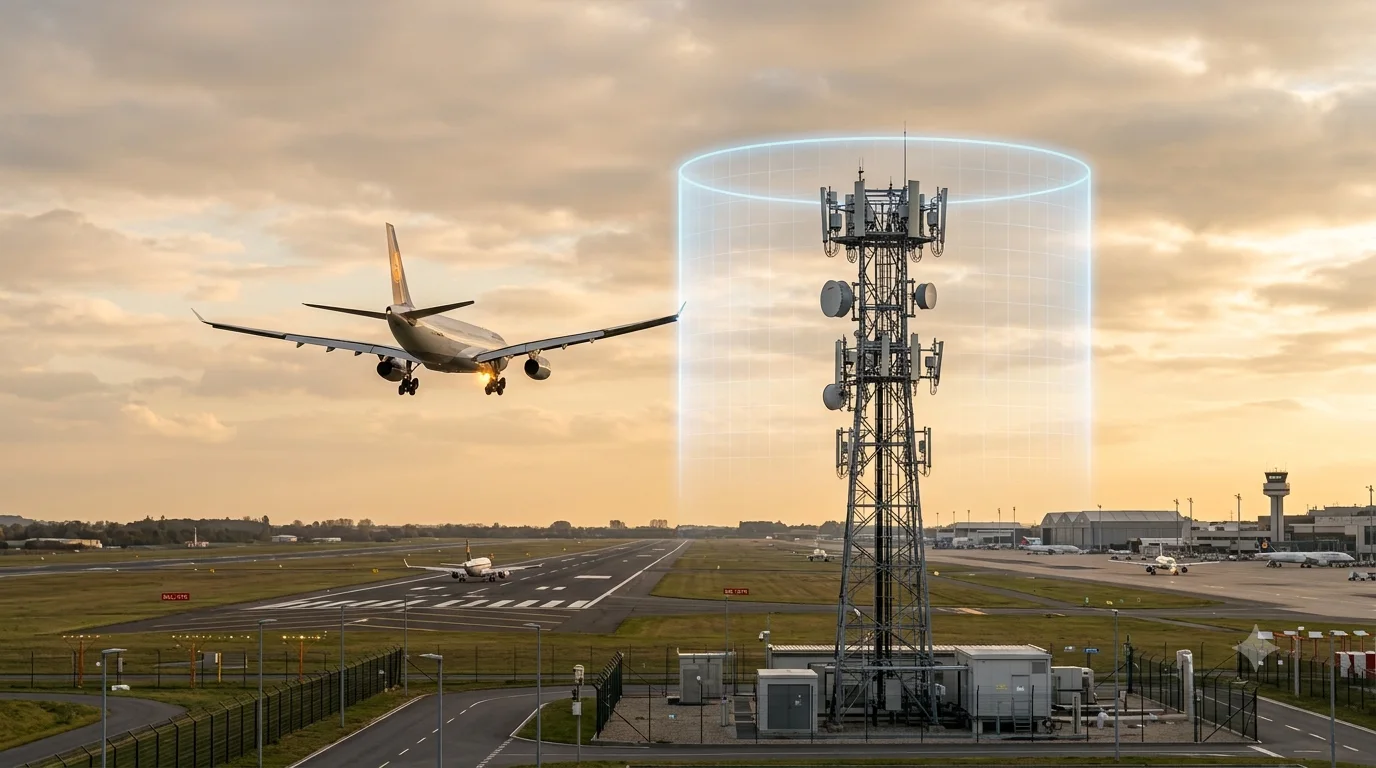
Yes, a mobile or telecom tower needs an airport NOC (height clearance from the Airports Authority of India) if it is built within the safeguarding radius of an airport, up to 20 km from a VFR airport or up to 56 km from an IFR airport, or if its height crosses the limits set in the NOCAS rules. Every wireless tower also needs SACFA clearance from the Department of Telecommunications. Our Airport NOC survey services handle the coordinates, elevation data and NOCAS filing that a mobile tower airport NOC depends on.
Get a Free NOC Feasibility Check
Mobile Tower Airport NOC at a Glance
- Short answer: It depends on location and height. Towers near airports need an AAI NOC. Towers far from airports may be auto-cleared.
- Who issues it: Airports Authority of India (AAI), through the NOCAS portal, under GSR 751(E) of 2015.
- Radius: Up to 20 km from VFR airports and up to 56 km from IFR airports, measured from the Aerodrome Reference Point.
- Two clearances: SACFA (DoT) for the radio installation and AAI NOC for height. The two systems are integrated.
- Data needed: WGS-84 coordinates and AMSL site elevation from a certified survey.
- Typical timeline: AAI’s charter promises 30 working days. Clean applications often clear faster.
- Risk of skipping it: Demolition or height reduction orders, even if a local permit exists.
Do Telecom and Mobile Towers Need an Airport NOC?
The rule is not “every tower needs an NOC” or “no tower needs one”. The requirement comes from GSR 751(E), the 2015 Ministry of Civil Aviation notification that protects the airspace around civil aerodromes. It covers any structure that could rise into that airspace, and mobile towers, TV and radio masts, OFC poles above threshold height and power transmission towers are all named in practice.
So the real question is: where is the tower and how tall is it?
- Inside the airport radius: An AAI NOC is needed, and the permitted height depends on how close the site is to the runway.
- Outside the radius and within the auto-settle height: NOCAS may auto-settle the case and issue a system letter confirming no NOC is required.
- Near a defence airfield: Clearance follows a separate Ministry of Defence route. See our guide on defence and IAF height clearance NOC.
Two Approvals, One Tower: SACFA and AAI NOC

Telecom towers face two separate checks, and people often mix them up.
| Approval | Issued By | What It Checks |
|---|---|---|
| SACFA clearance | Department of Telecommunications (WPC Wing) | Radio frequency siting, tower location and height for wireless installations |
| AAI NOC (height clearance) | Airports Authority of India via NOCAS | Whether the tower height is safe for aircraft operations near an airport |
AAI and the defence communication body JCES are part of the SACFA committee, and AAI’s NOCAS system is integrated with the SACFA server so telecom operators do not file twice. AAI’s own circular describes that after processing, AAI issues the NOC online to SACFA and the SACFA application is updated automatically. DoT’s hosts the SACFA procedures.
If a mast already holds a height NOC, adding more antennas to it is not a problem as long as the structure stays within the height limit stated in that NOC.
When a Mobile Tower Needs an Airport NOC: Quick Scenarios
| Scenario | Airport NOC Needed? |
|---|---|
| Ground-based tower within 20 km of a VFR airport | Yes, filed through NOCAS |
| Rooftop tower in a city within 56 km of an IFR airport | Yes. Building height plus tower height is assessed together |
| Tower far beyond the airport radius, within auto-settle height | Usually auto-settled, no manual NOC |
| Additional antennas on a tower that already has an NOC | No new NOC if the height stays within the existing limit |
| Temporary mobile tower or crane at a site near an airport | Yes, temporary structures also need clearance |
| Tower near an IAF, Army or Navy airfield | Defence clearance route applies |
How the Airport Radius Works for Towers

The radius is measured from the airport’s Aerodrome Reference Point (ARP). Our guide on VFR vs IFR airport NOC distance zones explains why:
- VFR airports: Up to 20 km radius. Typically smaller airports and airstrips.
- IFR airports: Up to 56 km radius. Major hubs such as Delhi, Mumbai, Bengaluru, Hyderabad and Chennai.
Inside the zone, permitted height is not one flat number. It falls as you get closer to the runway, following the Obstacle Limitation Surface, a concept defined in ICAO Annex 14. If your site falls in more than one airport’s zone, the stricter limit governs.
Auto-Settle Rules for Telecom Masts
Not every tower goes through manual review. According to the NOCAS conditions covered in our guides, a case can be auto-settled if the site lies beyond the applicable airport zone and the structure stays at or below 150 metres above ground level. Wireless telecom masts have a tighter condition: they auto-settle when beyond 10 km of a VFR airport and below 100 metres in height.
These conditions are set by AAI and can be updated, so always confirm on NOCAS before assuming a tower is exempt. A tall tower far from an airport can still need an NOC.
Rooftop Towers: Height Includes the Building
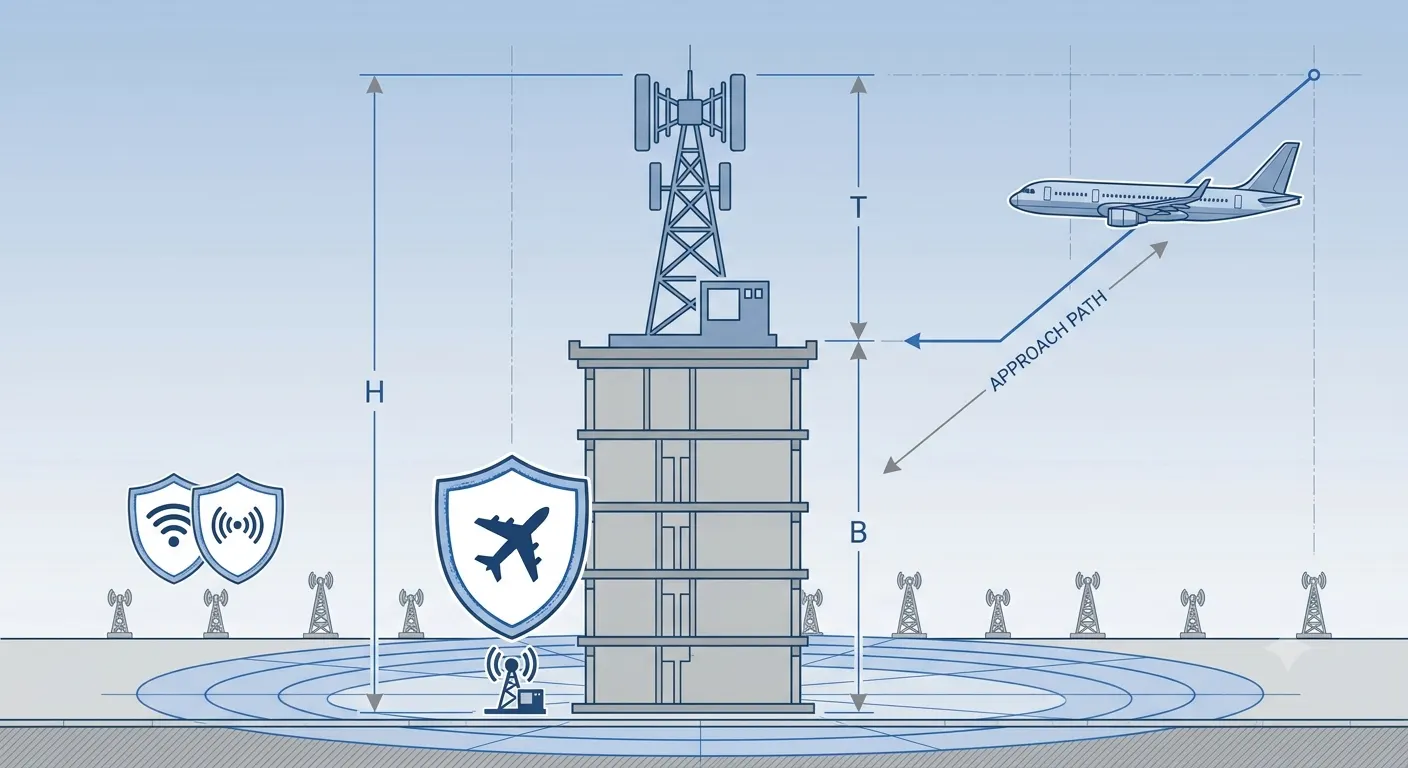
This is the most common mistake in the telecom sector. For a rooftop tower, AAI looks at the total height above mean sea level: site elevation + building height + tower or pole height. A modest 15 metre pole on a 40 metre building near an airport is a 55 metre structure from AAI’s point of view. Compare that total with the Permissible Top Elevation (PTE) for the site. If your total exceeds the PTE, the NOC can be restricted or rejected. Our building height restriction near airports guide explains how PTE is calculated.
What About Transmission Line Towers?
Power transmission towers and long OFC or power corridors are covered in the same way as other tall structures. Each tower location near an airport can need a height clearance, and corridor projects often file many applications. A detailed transmission tower AAI NOC workflow starts with accurate coordinates and elevation for every tower point. For long corridors, a LiDAR survey can also map terrain and obstacles along the route.
How to Get an Airport NOC for a Mobile Tower: Step by Step

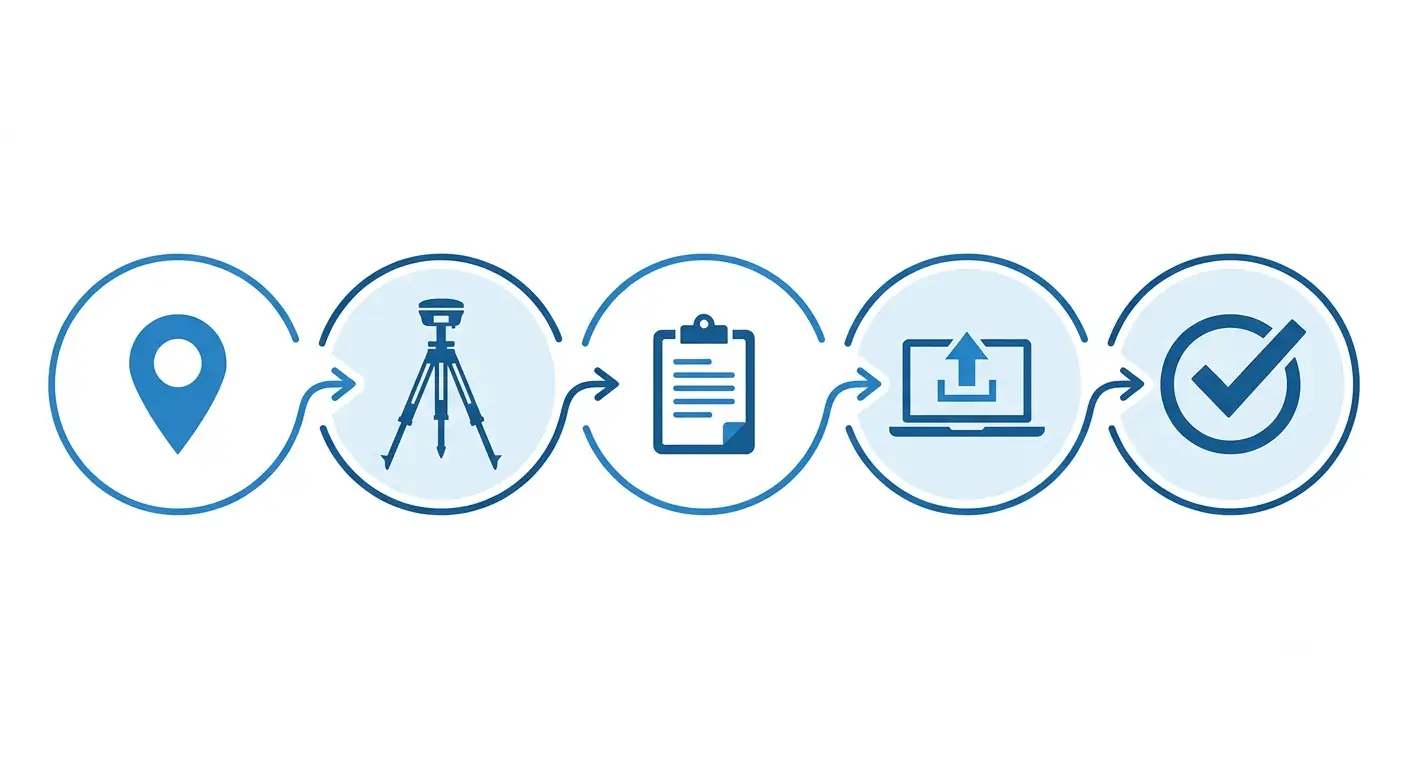
- Check airport distance and type. Identify the nearest airport, its VFR or IFR status and your distance from the ARP.
- Check zoning. If a Colour Coded Zoning Map applies, see what is CCZM. Local bodies can approve heights within the PTE directly in covered cities.
- Do a certified survey. Capture WGS-84 coordinates and AMSL elevation with RTK-GNSS or DGPS. See our site elevation survey for airport NOC and DGPS survey services.
- Prepare documents. Use our documents required for airport height clearance NOC checklist and NOCAS application documentation guide.
- File on NOCAS. Choose the correct structure category. For wireless masts, the SACFA-integrated route pulls geo-data from the SACFA server. Follow the NOCAS portal application process.
- Answer queries quickly. An unanswered query stops the clock.
- Do not build before the NOC. Follow all conditions in the issued NOC, including obstruction marking and lighting where specified.
How Long Does It Take?
AAI’s service charter allows up to 30 working days, split across document verification, technical scrutiny and final issuance. Our AAI NOC approval timeline guide covers real-world data: clean applications often clear in around 25 days, while rejections can be flagged within days.
For telecom, the Government has also tried to speed things up. Under the 2021 telecom reforms, DoT directed that tower applications pending with AAI and JCES beyond 30 days be treated as cleared, with the condition that physical construction should not start before the 16th day after clearance, as reported by Developing Telecoms. Do not rely on deemed clearance without written confirmation from the portal, because a later enforcement action can still treat an obstruction as unauthorised.
Documents Usually Needed
- WGS-84 coordinate certificate and AMSL elevation certificate from an authorised surveyor
- Tower drawing showing total height, and building drawings for rooftop sites
- Site plan with location marked
- Land ownership proof, lease or landlord consent for the site
- Authorisation letter if the applicant is not the owner
- Photo ID and applicant details for NOCAS registration
- SACFA application or reference, where applicable
- Fee payment confirmation
Why Tower NOC Applications Get Rejected
- Coordinates in the wrong datum or not matching the plot
- Elevation certificates from an unauthorised source
- Total height (building plus tower) above the PTE
- Missing ownership or landlord documents
- Unanswered NOCAS queries
For the full list, read why airport NOC applications get rejected.
Penalties for Building a Tower Without an NOC
A municipal or panchayat permission does not replace an AAI NOC, because they come from different authorities and test different things. Authorities can order demolition or height reduction of an obstruction in protected airspace. Our GSR 751(E) guide covers the Aircraft (Demolition of Obstructions caused by Buildings and Trees) Rules, 2023. For telecom operators, an unlawful tower also risks service shutdown and cost of dismantling.
AAI NOC vs DGCA: Which One Does a Tower Need?
For a tower, you apply to AAI through NOCAS. DGCA frames the Civil Aviation Requirements AAI follows, but it does not issue individual tower height NOCs. If you also use a drone for the site survey near an airport, that flight needs separate drone permission. See AAI NOC vs DGCA clearance for the difference.
Other Structures That Need the Same Clearance
If you also plan other tall structures near an airport, see our guides on solar power project AAI NOC, wind turbine and windmill AAI NOC and building height clearance AAI NOC.
Airport NOC Survey Services Across India
Surveying India supports tower and structure NOC surveys near airports in Delhi NCR, Mumbai, Bengaluru, Ahmedabad, Jaipur, Lucknow, Chandigarh, Bhopal, Kota, Nagpur, Indore, Varanasi, Patna, Raipur, Guwahati, Surat and Dholera.
Frequently Asked Questions
Do mobile towers need an airport NOC?
Yes, if the tower is within the airport safeguarding radius or exceeds the NOCAS limits. The radius is up to 20 km for VFR airports and up to 56 km for IFR airports. Towers beyond these limits and within the auto-settle conditions may be cleared automatically.
Who gives the airport NOC for a telecom tower?
The Airports Authority of India issues it through the NOCAS portal under GSR 751(E). Telecom towers also need SACFA clearance from the Department of Telecommunications, and the two systems are integrated.
Is SACFA clearance the same as an airport NOC?
No. SACFA clearance checks radio frequency siting and tower location, while the AAI NOC checks height safety for aircraft. Wireless towers can need both.
Do rooftop mobile towers need an airport NOC?
Yes, if the location falls in an airport zone. AAI assesses the combined height of the building and the tower above mean sea level, not only the pole height.
How far from an airport can I build a mobile tower without an NOC?
Beyond the airport radius and within the NOCAS auto-settle conditions, no manual NOC is generally needed. Confirm on NOCAS, since conditions are set by AAI and can change.
How long does a tower airport NOC take?
AAI’s charter allows up to 30 working days. Complete, accurate applications often clear sooner, while queries or height issues can extend the timeline.
What documents are required for a mobile tower airport NOC?
You need WGS-84 coordinates, an AMSL elevation certificate, tower and site drawings, ownership or landlord documents, an authorisation letter where relevant and fee payment proof.
What happens if I build a mobile tower without an airport NOC?
Authorities can order demolition or height reduction, even if you have a local permit. It can also disrupt network rollout and increase costs.
Do I need a new NOC to add antennas to an existing tower?
Not if the tower already has an NOC and the structure stays within the height limit given in it.
Does a transmission line tower need an airport NOC?
Yes, if it falls within an airport’s zone or exceeds the NOCAS conditions. Each tower location near an airport can need clearance.
Conclusion
A mobile tower airport NOC is not required everywhere, but it is required wherever a tower rises into protected airspace. The two decisive facts are distance from the nearest airport and total height above mean sea level. Check both early, combine SACFA and NOCAS correctly, and file with certified survey data to avoid queries and rejections.
Planning a tower near an airport? Explore our Airport NOC survey services or contact our team for a feasibility check. You can also email info@surveyingindia.in.