Documents Required for Airport Height Clearance NOC in India
Do you have your building drawings ready but no idea which certificates AAI actually wants? This is exactly where most airport NOC applications stall. Not because the applicant did anything wrong on purpose. Rather, because the required document list changes depending on what you’re building.
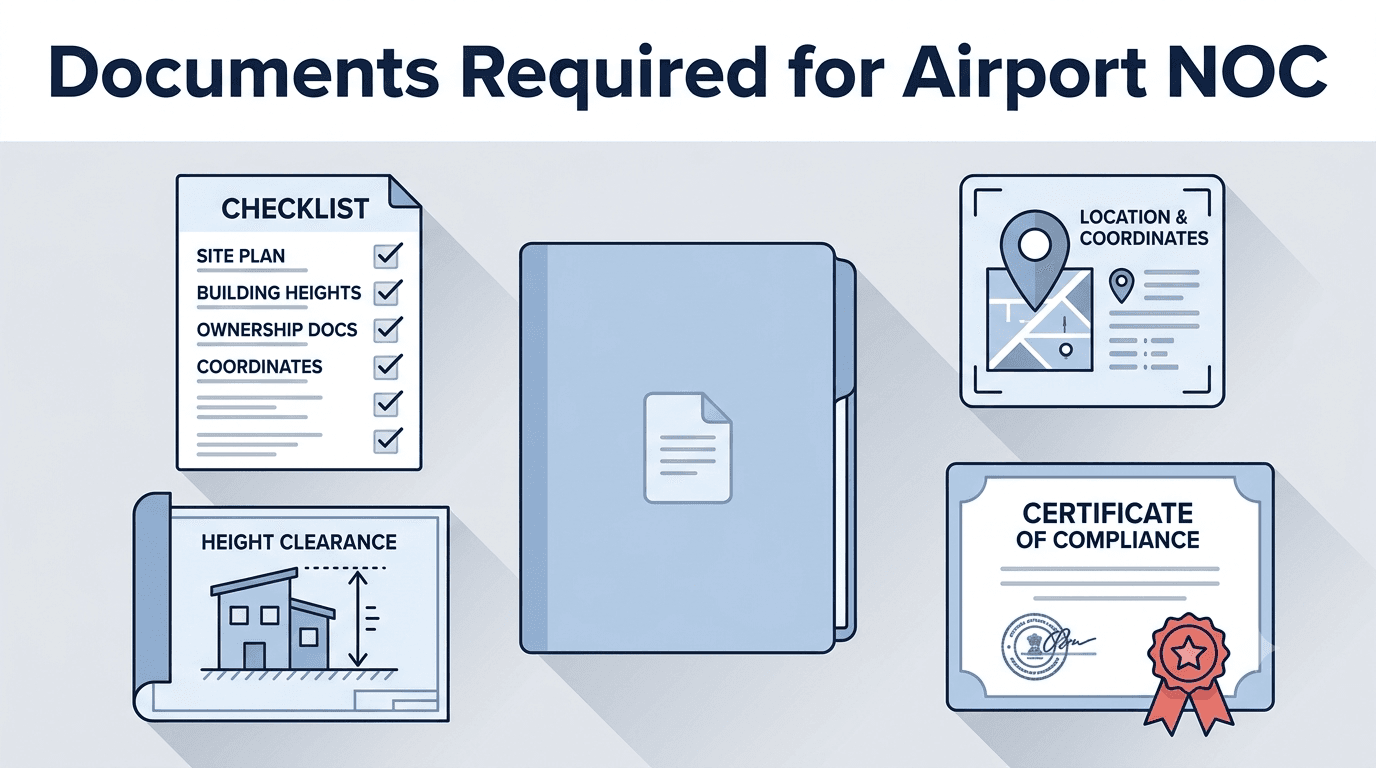
The documents required for airport NOC include certified WGS-84 GPS coordinates, an AMSL site elevation certificate, structural drawings, ownership proof, and a structure-specific undertaking form. Masts, chimneys, transmission lines, and windmills each need additional papers on top of this base list. Miss even one document, and AAI’s technical review will flag your application, adding weeks to your timeline.
This guide gives you the complete, accurate checklist of documents required for airport NOC, broken down by structure type, so you can gather everything correctly before you file.
Why Document Accuracy Matters So Much
Unlike a typical municipal approval, AAI’s NOC decision works as a pure calculation. The NOCAS portal computes your Permissible Top Elevation directly from the coordinates and elevation figures you submit. So, if your actual site data ever turns out to differ from what you declared, AAI can render the issued NOC null and void, even after approval. Therefore, before we list the documents, understand this clearly: precision here isn’t a formality. It forms the entire basis of your approval.
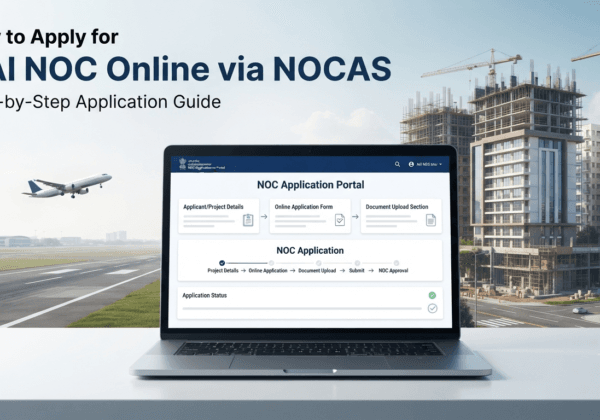
Our detailed NOCAS portal application process guide covers how these documents fit into the filing workflow. This article, however, focuses purely on what to gather before you start.
Core Documents Required for Every Airport NOC Application
Regardless of structure type, every applicant needs these baseline documents.
1. WGS-84 Coordinate Certificate
You need surveyed site coordinates in WGS-84 datum, specified to at least 7 digits of precision (degrees, minutes, seconds), for every corner of your plot. A qualified professional, or an agency authorised by your local government body, must issue this certificate. Acceptable sources include Survey of India, CPWD, and State PWD.
2. AMSL Site Elevation Certificate
Alongside coordinates, you need your site’s elevation Above Mean Sea Level (AMSL). NOCAS uses this figure, combined with your coordinates, to calculate exactly how much height your structure can legally reach. Our site elevation survey service provides both coordinate and elevation data in the exact format NOCAS requires.
3. Structural Drawings and Site Plan
You need drawings that clearly show your proposed structure’s height, floor plan, and elevation view. Additionally, you need a site plan showing the plot’s surrounding context and boundaries.
4. Ownership or Lease Documents
AAI needs proof that you have the legal right to build on the site. In practice, this means land ownership documents, or a registered lease deed if you don’t own the land outright.
5. Authorization Letter (If Applicable)
If you’re filing on behalf of the owner, whether as an architect, consultant, or contractor, you need a signed authorization letter from the property owner.
6. Photo ID for Registration
To register on NOCAS, you need one of the following: Voter ID, Aadhaar card, PAN card, or Passport.
7. Signed Undertaking Form
Every applicant submits a signed declaration confirming they will comply with the terms of the issued NOC, including any conditions on structure height or obstruction marking.
Additional Documents by Structure Type
Beyond the core documents above, AAI asks for extra papers depending on what you’re building. Here’s the breakdown.
For Buildings and Residential/Commercial Structures
- Approved building plan or layout, if your local municipal authority has already sanctioned one
- Detailed elevation drawing showing total proposed height
- For plots larger than 5,000 sqm, or conjoint buildings, additional documentation applies under AAI’s Appellate Committee guidelines dated 16th January 2025
You can find the full checklist for construction projects in our building height clearance guide.
For Masts and Towers (Non-SACFA)
- Surveyed site elevation and coordinates of the mast’s centre point, to at least 7-digit precision
- Structural design certificate confirming mast height and stability
For SACFA Wireless Communication Masts
Telecom masts registered under the SACFA (Standing Advisory Committee on Radio Frequency Allocation) system follow a different route. Since AAI’s servers integrate directly with SACFA, applicants generally don’t need to submit separate elevation certificates. Instead, AAI fetches the mast’s geo-data automatically from the SACFA database, calculates height clearance, and returns the result to SACFA’s system. In fact, applicants filing through this integrated route don’t need to submit any hard copy documents at all.
For Chimneys
- Surveyed coordinates and elevation certificate for the chimney’s base
- Structural drawing showing total chimney height, including any future extension plans
For Power Transmission Lines
- Route map showing the transmission line’s path relative to the airport
- Tower height details at each critical point along the route
- A signed Undertaking Form 1B, specific to power transmission line applications
For Windmills and Solar Power Projects
- Site coordinates and elevation for each turbine or panel installation point
- A signed Undertaking Form 1F, specific to windmill applications
- Layout plan showing the full project boundary, since wind and solar installations often span large areas with multiple structures
Our guides on wind turbine and windmill AAI NOC and solar power project AAI NOC go into further detail on layout-specific documentation.
If Your Site Falls Within Airport Premises
If your proposed structure happens to sit within the airport’s own boundary, you additionally need a formal approval letter from the airport operator, on top of the standard NOCAS documentation.
NOC Revalidation: Documents You’ll Need Later
An issued NOC doesn’t last forever. Under AAI’s guidelines, a building NOC remains valid for 5 years from the date of issue, extendable through revalidation up to a maximum of 8 years. Masts, chimneys, and transmission lines get an initial validity of 7 years, extendable up to 12 years in total.
If your construction is still in progress, or already complete, when your NOC nears expiry, you can apply for revalidation through NOCAS. For this, you’ll need the following:
- A signed undertaking on Form 1C, confirming the current status of construction
- Your original NOC-ID and issue details
- An acknowledgement that your Permissible Top Elevation may change upon fresh assessment, and that you accept the revised figure
File Format and Upload Tips
NOCAS runs as a fully paperless system, so you upload scanned copies rather than mail physical documents in most cases. Keep these formatting points in mind before you upload:
- Save all documents as PDF files, scanned clearly enough that text and coordinate figures stay legible after upload.
- Keep individual file sizes reasonable. Oversized scans can fail to upload or slow down your submission.
- Name your files descriptively, such as “Site_Elevation_Certificate.pdf” or “Ownership_Proof.pdf.” This keeps your application organised if AAI’s reviewer requests clarification later.
- Cross-check every number in your uploaded PDF against what you typed into the application form. Even a single-digit mismatch between the two can trigger a rejection.
Common Documentation Mistakes to Avoid
- Submitting coordinates in the wrong datum. NOCAS accepts WGS-84 only. Coordinates from a different reference system get rejected during technical scrutiny.
- Using an uncertified elevation source. Only certificates from Survey of India, CPWD, State PWD, or an authorised agency meet NOCAS’s standards. A private, non-accredited survey won’t pass review.
- Filing duplicate applications for the same coordinates. NOCAS permits only one active application per set of coordinates. As a result, a duplicate filing gets flagged, not fast-tracked.
- Forgetting the structure-specific undertaking form. Power lines need Form 1B, windmills need Form 1F, and revalidation needs Form 1C. Missing these delays scrutiny, even when everything else checks out.
- Mismatched details between the form and uploaded documents. AAI’s review compares your typed entries against your scanned documents. Any inconsistency, however small, will trigger a rejection or a query.
How Surveying India Prepares Your Documentation
Getting the paperwork right the first time is exactly where most applicants need help, and it’s exactly where we focus. Our team prepares certified WGS-84 coordinates and AMSL elevation certificates using RTK-GNSS equipment, accurate to within ±5 cm. Beyond that, we compile the complete, structure-specific document set your application actually needs, whether that’s a building, a mast, a chimney, a transmission line, or a windmill. You can review our full NOCAS application and documentation service for a detailed breakdown by project type. Alternatively, explore our broader Airport NOC survey services for end-to-end support.
Frequently Asked Questions
What documents are required for an airport NOC application? You need a WGS-84 coordinate certificate, an AMSL site elevation certificate, structural drawings, ownership or lease proof, a photo ID, and a signed undertaking form, along with structure-specific documents depending on your project type.
Who can issue the site elevation certificate for NOCAS? Survey of India, CPWD, State PWD, or a government-approved agency authorised for this purpose can issue it. A qualified professional working under such an agency’s certification also qualifies.
Do telecom masts need the same documents as buildings? No. SACFA-registered wireless communication masts follow an integrated data-sharing route with AAI. As a result, applicants generally don’t need to submit separate elevation certificates or hard copy documents.
What is Undertaking Form 1B? Form 1B is the signed undertaking specifically required for power transmission line NOC applications, confirming compliance with the issued height clearance conditions.
What is Undertaking Form 1F? Form 1F is the undertaking required for windmill NOC applications, confirming the applicant’s compliance with AAI’s height clearance terms.
How long is an airport NOC valid? A building NOC stays valid for 5 years initially, extendable to 8 years through revalidation. Masts, chimneys, and transmission lines get 7 years initially, extendable to 12 years.
What documents do I need for NOC revalidation? You need a signed undertaking on Form 1C, your original NOC-ID, and an acknowledgement that AAI’s fresh assessment may revise your Permissible Top Elevation.
Can I submit a NOC application without a certified elevation certificate? No. NOCAS requires certified WGS-84 coordinates and AMSL elevation data before it can calculate your Permissible Top Elevation. Applications without this data cannot move forward.
Not sure which documents apply to your project? Contact our survey team — we’ll prepare your complete, structure-specific NOCAS documentation and handle the filing for you.