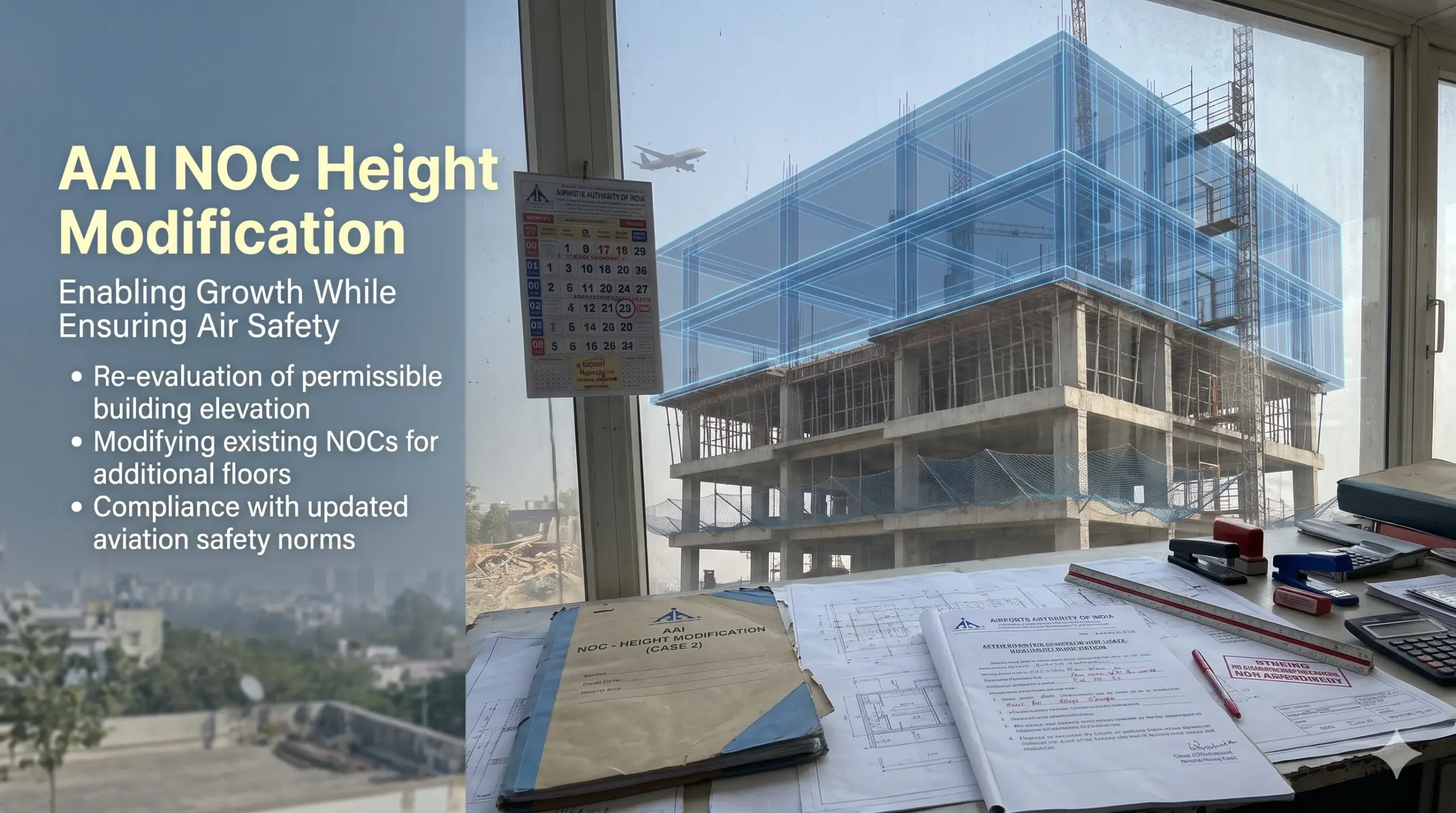
We found no AAI form called height modification. To change the height of an existing AAI NOC, you file a review once with Undertaking 1D, or appeal to the Appellate Committee. This guide shows which route fits, with steps, documents and a worked example. See also AAI NOC validity and revalidation.
Quick Answer
- More height wanted: file a review with the Designated Officer, once only, with Undertaking 1D.
- Still not enough, or you disagree: appeal to the Appellate Committee (₹2,00,000 plus GST).
- Lower height or same height: a structure within the NOC’s top elevation complies. Check that your sanctioned plan and rooftop items match.
- Check the zoning map first: if your new top elevation is at or below the CCZM limit, your local body may clear it without AAI.
How AAI Handles Height Changes
| Your situation | Route |
|---|---|
| Got less height than requested, or want more, construction not started | Review (once), Undertaking 1D |
| NOC granted, construction started or completed, want more height | Review (once), Undertaking 1D |
| Review done, still want more, or you disagree with the decision | Appeal to the Appellate Committee |
| New top elevation within the CCZM permitted level | Local body may approve, without AAI |
| Adding a separate structure on the same plot | Separate application for that structure |
| NOC about to expire | Revalidation (height does not change) |
| Original survey data was wrong | Correct the data first. See wrong coordinates NOC rejected |
If you are still working out whether you need an NOC at all, start with what is AAI NOC and who needs it and the 5-minute AAI NOC required checklist.
Route 1: Review Application (Once Only)
AAI’s guidelines allow one review application to the Designated Officer, with Undertaking 1D, in two situations:
- You did not get the requested height, or because of a plan change you now want more height, and construction has not started.
- The NOC was issued for the requested or restricted height, and construction has started or is complete, but you want a higher height.
You file it from your NOCAS dashboard, which has options to apply for review, revalidation and appeal. AAI may also ask for architectural drawings (site plan, section and elevation with scale and north direction) for a detailed examination, and they must show everything planned above the structure, such as aerials, lightning arresters, vent pipes and overhead water tanks.
A Point to Read Carefully
Form 1D includes a statement that the permissible top elevation after re-assessment may differ from the previously granted height and will be acceptable to you. AAI’s 2017 circular, on the other hand, says a granted height is not reduced on review or appeal during the NOC’s validity. Because both appear in AAI’s documents, read the current form on NOCAS and ask the Designated Officer if you are unsure.
Review Steps
- Check the NOC. Note its validity, NOC ID and permissible top elevation.
- Fix the new target. Calculate the revised top elevation (AMSL), including all rooftop items.
- Get a fresh survey if anything changed. See our site elevation survey for airport NOC guide.
- Check the zoning map and the approximate top elevation on NOCAS to gauge what is realistic.
- Prepare Undertaking 1D, stating the construction status and level reached.
- File the review on NOCAS with the NOC copy, drawings and certificates.
- Respond to any queries. AAI says an accepted application is processed within 15 working days. See the AAI NOC approval timeline for real-world ranges.
Note that NOCAS lets you file only one application for the same set of coordinates, and duplicates are not processed. That is why a height change goes through review, not a second fresh application.
Route 2: Appeal to the Appellate Committee
If the review does not give you the height you need, or you disagree with the Designated Officer’s decision, you can appeal. The fee is ₹2,00,000 plus GST, you need an architect’s justification letter citing the State or local rule that makes the requested height permissible, and the appeal must fall within the NOC’s validity. Under AAI’s guidelines, online appeals are possible for NOCs issued through NOCAS on or after 1 January 2016, and the fee link must be paid within seven days after verification, or the appeal is rejected. Read the full process in our AAI NOC appeal guide, and our AAI NOC objection reply page for ready review and appeal formats.
Route 3: Check Whether You Need AAI at All
Where AAI has issued a Colour Coded Zoning Map, it shows the permissible top elevation for each grid. AAI’s guidelines say the purpose of the map is to empower local bodies to clear proposals whose top elevation is below the CCZM elevation, without referring to AAI, up to 150 m. If your revised top elevation stays within the CCZM level and the site is not in an area that requires an NOC, you may not need a review at all. Read our colour coded zoning map guide and confirm with your local body.
Reducing Height or Making Minor Design Changes
An NOC gives a maximum top elevation. A structure that stays within it, including every rooftop installation, is within the NOC. We found no AAI requirement to modify an NOC just to build lower, but check these points:
- Your sanctioned drawings and AAI application should still match.
- Rooftop items must not project above the permissible top elevation.
- If the plot, coordinates or structure footprint change materially, confirm with the AAI NOC office.
Worked Example (Illustrative Numbers)
- NOC permissible top elevation: 240 m AMSL
- Site elevation (highest point): 215.40 m AMSL
- Maximum structure height: 240 − 215.40 = 24.6 m
The developer now wants two more floors, adding 6 m, so the building becomes 30.6 m and the top elevation becomes 246 m AMSL. That is 6 m above the NOC. Options:
- Redesign back to 24.6 m or less.
- Check the CCZM. If the grid permits 246 m or more, the local body may approve it.
- File a review with Undertaking 1D, stating the construction status.
- Appeal, with the architect’s justification, if the review does not succeed.
These numbers are examples only.
Special Cases
- More than one structure on a plot: AAI’s guidelines say a separate application per structure is desirable. Otherwise, the system restricts the whole cluster to the minimum permissible height within the plot.
- Antennas on a mast: AAI has no objection to multiple antennas on a mast with an NOC, as long as the height stays within the NOC limit. Raising the mast itself is a height change. See mobile tower airport NOC rules.
- Alterations to an existing building: attach a copy of the earlier NOC to the new application.
- Rooftop additions: water tanks, lift machine rooms and antennas count toward the top elevation. See building height clearance AAI NOC.
- Transmission towers, solar and wind: each has its own rules. See transmission tower AAI NOC, solar power project AAI NOC and wind turbine and windmill AAI NOC.
- Near a military airfield: a defence clearance is separate. Use the defence NOC or AAI NOC flowchart.
Documents for a Height Change Request
| Document | Review | Appeal |
|---|---|---|
| Copy of the existing NOC | Yes | Yes |
| Undertaking 1D (₹10 stamp paper) | Yes | Yes |
| Revised drawings with new top elevation | Yes, if asked | Yes |
| Site coordinates and elevation certificates | Yes | Yes, all corners and all buildings |
| Authorisation letter | If an agent files | If the applicant differs |
| Architect’s justification letter citing the rule | Not listed | Yes |
| Appeal fee proof (₹2,00,000 plus GST) | No | Yes |
For the paperwork, see documents required for airport height clearance NOC and the NOCAS application documentation guide. For survey quality, read RTK-GNSS vs traditional GPS survey accuracy.
Mistakes to Avoid
- Building above the NOC’s top elevation while waiting for approval
- Forgetting that a review can be filed only once
- Counting only floors and forgetting rooftop items
- Filing after the NOC has expired
- Using new coordinates or elevation that do not match the survey
- Treating a local body’s sanction as a substitute for an NOC where one is needed
- Skipping the architect’s rule-based justification in an appeal
Also compare your case against common airport NOC rejection reasons.
Frequently Asked Questions
Can I increase the height of an existing AAI NOC?
You can apply for a review, once, with Undertaking 1D. If that does not work, you can appeal to the Appellate Committee.
Is there an AAI form for height modification?
We found none. AAI’s guidelines use the terms review, revalidation and appeal.
How many times can I file a review?
Once.
Can I file a review after construction has started?
Yes. AAI’s guidelines cover cases where the NOC was issued, construction has started or completed, and you want a higher height.
Can I file a fresh NOC application for more height?
NOCAS accepts only one application for the same set of coordinates, and duplicates are not processed. Use review or appeal.
Do I need to change the NOC if I build lower?
We found no AAI requirement to do so, because the NOC sets a maximum. Make sure your plans and rooftop items remain within it.
Can the height go down after a review?
Form 1D says the re-assessed elevation may differ, but AAI’s circular says a granted height is not reduced during validity. Confirm with the Designated Officer before filing.
How long does a review take?
AAI says an accepted application is processed within 15 working days. Queries can add time.
Need Help Changing Your NOC Height?
Send us your NOC letter and the new height you need. We will check it against the zoning map and your survey data, and tell you whether to redesign, review or appeal. Visit Surveying India, see our airport NOC survey services in India and AAI NOC for height clearance in India, or contact us. We work in Delhi NCR, Mumbai, Pune and Ahmedabad. Verify current forms on NOCAS, the NOCAS circulars page and the Ministry of Civil Aviation website.
Last updated: 4 November 2026. This guide is informational. AAI’s current forms and your NOC letter govern your case.