
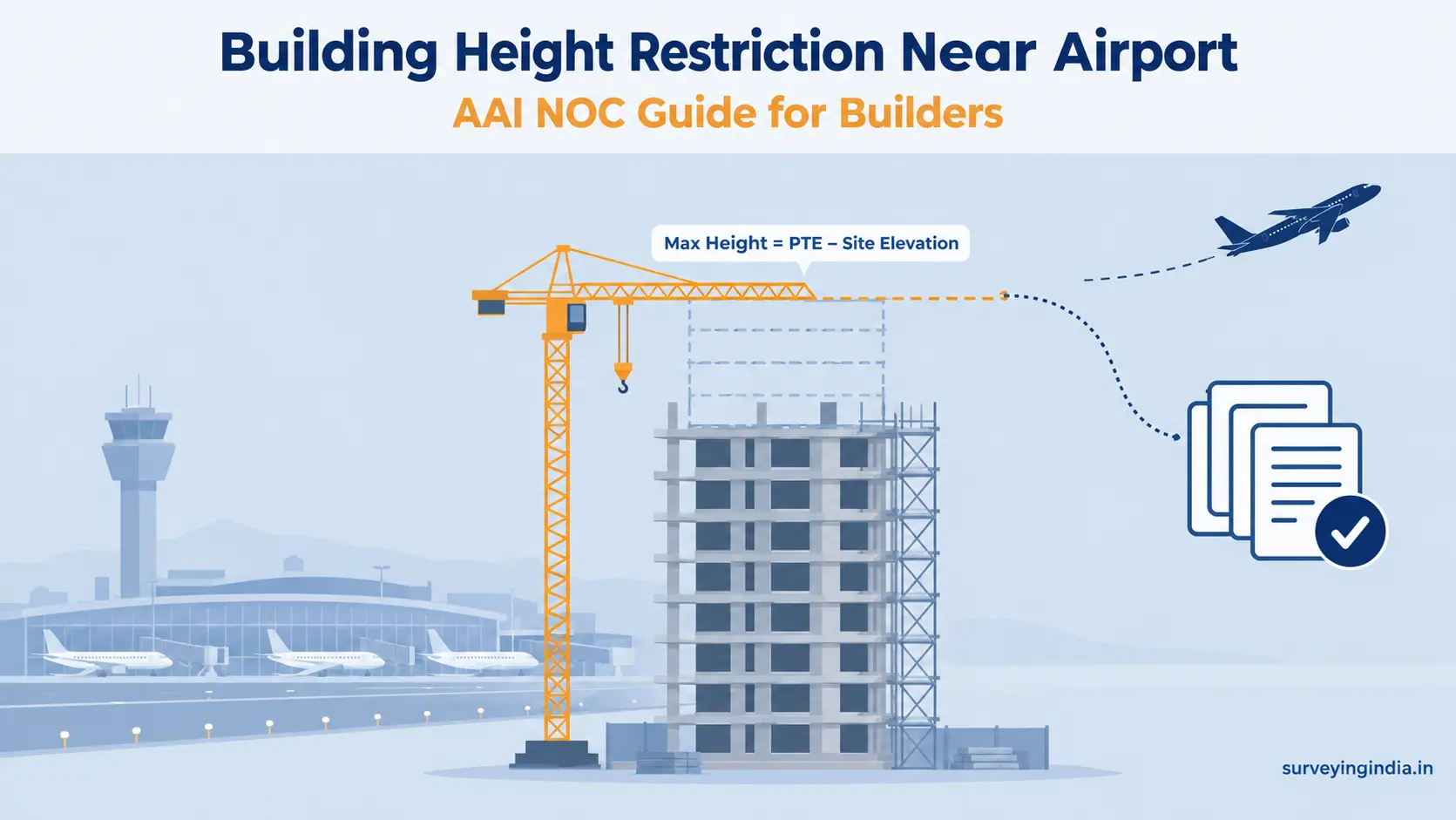
A building height restriction near airport applies to any site within 20 km of a VFR airport or 56 km of an IFR airport, measured from the Aerodrome Reference Point (ARP). Your maximum height is the Permissible Top Elevation (PTE) set by AAI minus your site’s ground elevation. You need an AAI NOC before construction begins.
You have bought a plot, the architect has drawn 18 floors, and the municipal plan is ready. Then someone asks: “Do you have the airport NOC?”
Every builder near an airport meets this question sooner or later. A building height restriction near airport is set by aviation safety law, not by your local building bylaws. If you learn about it late, it can cut floors, delay approvals, or stop a project entirely. This guide explains the rules in plain language so you can plan early.
What Is a Building Height Restriction Near Airport?
A building height restriction near airport is a legal cap on how tall any structure can be around an aerodrome. It protects the airspace aircraft use to take off, land and manoeuvre. It applies to buildings, towers, chimneys, masts, transmission lines and even trees.
In India, these limits follow ICAO standards and are enforced through the Aircraft Act, 1934. The current framework is GSR 751(E), issued by the Ministry of Civil Aviation on 30 September 2015. It replaced the earlier S.O. 84(E) of 2010.
(Internal link: read our full guide on GSR 751(E) and airport NOC rules.)
Who Needs an NOC? The Distance Rule
The NOC requirement depends on how far your site is from the airport and how tall your structure will be.
| Your site location | Structure height | AAI NOC needed? |
|---|---|---|
| Within 20 km of a VFR airport | Any height | Yes |
| Within 56 km of an IFR airport | Any height | Yes |
| Beyond 20 km (VFR) or 56 km (IFR) | Up to 150 m AGL | No |
| Beyond those distances | Above 150 m AGL | Yes |
Distances are measured from the ARP of the nearest airport. In dense cities, the zones of two airports can overlap, so check both. The building height restriction near airport that applies to you is always the stricter one.
Defence airfields work differently. For them, the NOC comes from the respective defence authorities, not AAI.
How AAI Calculates Your Maximum Height
You will not find one universal number. Your permitted height depends on exact coordinates, ground elevation and the flight procedures of that airport.
AAI checks three things and applies the most restrictive result:
- Aerodrome geometry (AGA): Obstacle Limitation Surfaces such as the approach, transitional, inner horizontal and conical surfaces.
- Navigation aids (CNS): Radar, VOR and other equipment must not be disturbed.
- Flight procedures (PANS-OPS): Instrument approach and departure paths must stay clear.
The inner horizontal surface, for example, generally caps height at roughly 45 m above ground near the runway. This is indicative only, and the exact figure varies by airport.
AGL vs AMSL: The Mistake That Costs Floors
AAI measures height above mean sea level (AMSL), not just above your ground. The formula is:
Permitted height = Permissible Top Elevation (AMSL) − Site elevation (AMSL)
Illustrative example: If the PTE for your grid is 215 m AMSL and your site sits at 190 m AMSL, you can build up to 25 m. If your surveyed elevation is wrong by 3 m, your final height, and possibly a floor, is wrong too.
What Is CCZM?
The Colour Coded Zoning Map (CCZM) divides the area around major airports into grids, each with a PTE. Local bodies can clear proposals below the CCZM elevation without referring to AAI, up to 150 m. If you request a higher elevation, you must apply on NOCAS.
Real-World Example: Why City Matters
Zone data published for Mumbai shows how tight a building height restriction near airport can get. Reported figures put the AAI-approval threshold at about 18 m at 4 km from the airport. At the same distance from Vijayawada airport, the reported threshold is over 42 m. Same rule, very different outcomes. Always work from your own plot’s coordinates, not a neighbour’s floor count.
How to Get Height Clearance: Step by Step
Follow this order. NOCAS is sequential, and skipping ahead usually causes rejections.
- Check your distance and zone. Measure from the ARP and check your CCZM grid.
- Get a certified site survey. You need WGS-84 coordinates and AMSL elevation, certified by an authorised surveyor. A professional DGPS survey gives the accuracy AAI expects.
- Register on NOCAS. Create your applicant login on AAI’s official NOCAS portal.
- File the application. Enter the site details, structure type and requested height, and upload documents.
- Respond to AAI queries. Answer objections quickly. Delays here are the most common cause of slow approvals.
- Receive the NOC and design within the PTE. Your architect must treat this as a hard ceiling.
- Revalidate or appeal if needed. You can apply for one-time revalidation before expiry if construction has started. If you disagree with the height granted, you can appeal to the Appellate Committee.
For a walkthrough of the portal screens, see our NOCAS application process guide.
Documents Checklist for a Building Height Restriction Near Airport Clearance
- Signed printout of the online application with NOC ID
- Site location plan authenticated by the municipal or development authority
- Surveyor’s certificate of coordinates and site elevation
- Undertaking on the prescribed form on non-judicial stamp paper
- Ownership or lease documents
- Drawings showing the proposed structure
Requirements are updated from time to time, so verify the latest list on NOCAS before filing.
Key Facts at a Glance
- Fee: AAI charges no fee for applying or obtaining the NOC.
- Validity: 8 years from the date of issue.
- Start of work: No construction may begin before the NOC is issued.
- Offices: AAI has nine NOC offices, including Delhi, Mumbai, Kolkata, Chennai, Guwahati, Ahmedabad, Bengaluru, Hyderabad and Nagpur.
Common Mistakes Builders Make
- Treating the building height restriction near airport as a municipal matter. Municipal sanction and AAI clearance are separate approvals. Having one does not give you the other.
- Using approximate elevation. Google Earth or contour guesses are not survey-grade.
- Building extra floors or rooftop structures. Water tanks, lift machine rooms and antennas count toward height.
- Starting excavation “just to save time.” The undertaking you sign forbids work before the NOC.
- Assuming a nearby project’s NOC applies to you. Each plot has its own coordinates and PTE.
- Ignoring NOC validity. An expired NOC on an unfinished building creates a fresh compliance problem.
What Happens If You Violate the Limits?
Non-compliance carries real consequences. In a 2017 case, the Bombay High Court directed DGCA to act against 45 buildings that breached their AAI NOCs. More recently, news reports (April 2026) describe rules that let the government demolish obstructing structures within a 20 km radius, after the owner is asked to submit a plan of the structure. Treat ignoring a building height restriction near airport as a legal and financial risk that can end in demolition, not as a paperwork issue.
Are the Rules Changing?
Yes, they are under review. In early 2026, the Ministry of Civil Aviation was reported to have started a pan-India study with ICAO on height regulations around airports, and some airports have seen revised limits. The building height restriction near airport framework may therefore evolve. Confirm current limits on NOCAS before you finalise designs.
How a Survey Partner Helps
Most rejections come from bad data, not bad design. At Surveying India, we help builders plan around a building height restriction near airport with survey-grade coordinates, elevation data and NOC documentation. We also run detailed contour surveys for site planning. If your project is near Ahmedabad, see our airport NOC survey in Ahmedabad.
Frequently Asked Questions
What is the building height restriction near airport in India?
It is the maximum height AAI allows for structures around an airport, calculated from your exact coordinates and elevation. NOC is required within 20 km of VFR and 56 km of IFR airports.
How far from an airport do height restrictions apply?
Up to 20 km from VFR airports and up to 56 km from IFR airports, measured from the Aerodrome Reference Point. Beyond that, structures up to 150 m AGL do not need an AAI NOC.
Is an AAI NOC mandatory for every building near an airport?
Yes, inside the notified distances, for any type of structure. Municipal approval alone is not enough.
How much does an AAI NOC cost?
AAI charges no fee for the NOC itself. Your costs are survey work, documentation and consultant fees, if you hire one.
How long is an AAI NOC valid?
Eight years from issue. You may apply for a one-time revalidation before expiry if construction has begun and the delay was beyond your control.
Who issues the NOC for defence airports?
The respective defence authorities issue it, not AAI.
Conclusion
A building height restriction near airport is a planning input, not a roadblock. Check your distance, get an accurate survey, file on NOCAS early, and design within the PTE. Builders who do this in the first month rarely face redesigns later.
Need site coordinates and elevation for your NOC application? Contact Surveying India for a survey-grade report.
Disclaimer: This article is for general guidance. Permissible heights depend on your exact site, so confirm on NOCAS or with a qualified consultant.