Ask five different consultants how long AAI NOC approval takes, and you’ll likely get five different answers. Some say two weeks. Others say three months. Neither answer is wrong, exactly. It depends entirely on what kind of application you file, and how clean your data is going in.
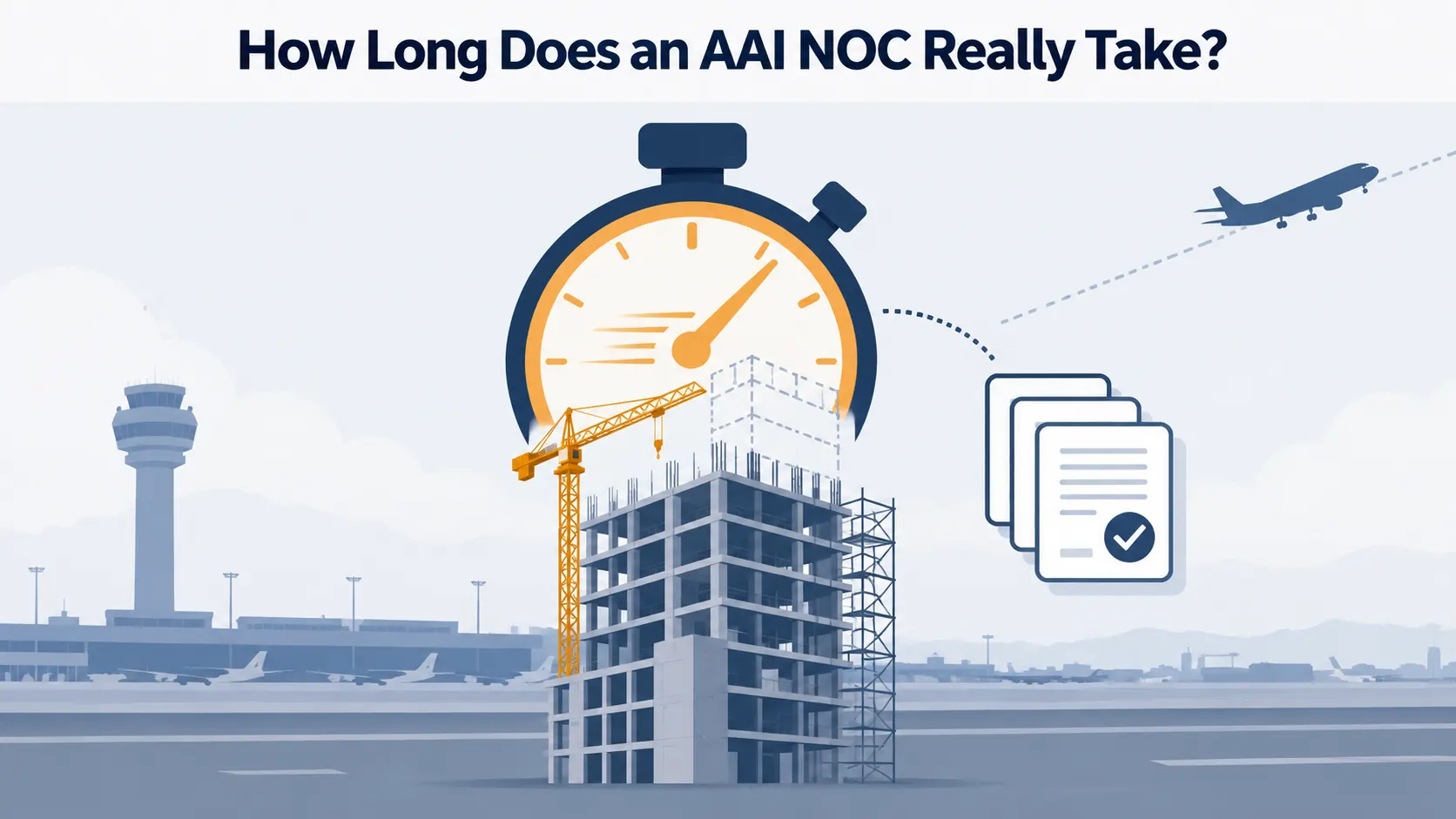
AAI’s official service charter promises NOC approval within 30 working days. Real-world data tells a different story, though. It shows a median approval time of around 25 days for clean applications, while rejected applications get flagged in as little as 3 days. Complex cases involving appeals, revalidation, or borderline height requests can stretch well beyond a month.
This guide gives you a realistic, sourced timeline for AAI NOC approval. You’ll learn what AAI officially promises, what actually happens in practice, and what you can do to stay on the faster end of that range.
AAI’s Official Service Charter: The Promised Timeline
AAI’s own Annexure-A service standards break the NOC process into three distinct stages, each with its own time limit:
| Stage | Official Timeline |
|---|---|
| Document verification | 5 working days |
| Technical scrutiny and NOCC clearance | 10 working days |
| Final NOC issuance | 5 working days |
| Maximum total settlement | 30 working days |
Notice that this is a maximum, not an average. A straightforward application with accurate data can clear faster than 30 working days. However, any query raised during technical scrutiny pauses this clock until you respond, so the 30-day figure assumes no back-and-forth.
What Actually Happens: Real Timeline Data
Official targets and real-world outcomes don’t always match, and this is exactly where a lot of applicants get caught off guard. An independent analysis of AAI’s public NOCAS portal data covered applications from 2016 through November 2024, across 12 states. It found a clear split in how long applications actually take.
Rejected applications move fast. AAI’s median time to reject sits at just 3 days. This tells you something important. Most rejections happen during initial verification, not deep technical review. A coordinate mismatch or formatting error gets caught almost immediately. Approved applications take considerably longer, with a median of 25 days from submission to approval. This 25-day median fits comfortably within AAI’s 30-working-day maximum. Even so, it also shows that few applications clear in the fastest possible window.
For context on how far NOCAS has improved processing speed: earlier, manual, pre-digital NOC processing in India often took a month or two. AAI introduced this online system specifically to fix that. NOCAS cut the timeline substantially, even accounting for today’s real-world 25-day median.
What Speeds Up Your Timeline
A few specific factors can push your application toward the shorter end of the range.
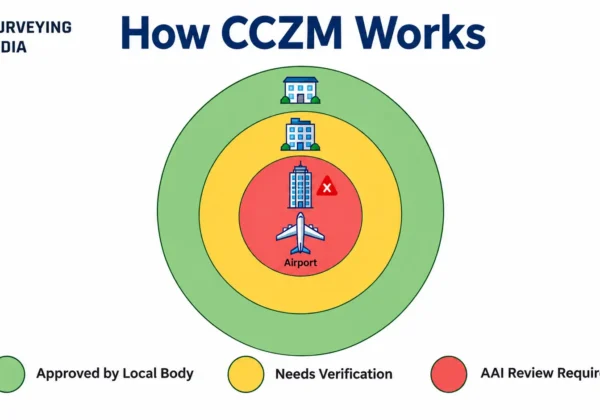
Your site falls within a CCZM-covered zone. A Colour Coded Zoning Map might apply to your site. If your requested height stays within the Permissible Top Elevation, your local municipal body can approve your proposal directly. This skips AAI’s individual review entirely, often cutting your timeline to days rather than weeks.
Your telecom mast qualifies for SACFA integration. Wireless communication masts processed through the SACFA-integrated route don’t need separate elevation certificates from AAI. The system pulls geo-data automatically, so this route typically moves faster than a standard building application.
Your data is accurate and complete on the first submission. This sounds obvious, but it’s the single biggest lever you control. Applications with correctly formatted WGS-84 coordinates and AMSL certificates rarely trigger queries. Unanswered queries, in turn, are one of the most common causes of delay beyond AAI’s own targets.
What Slows Down Your Timeline
Just as clearly, a few patterns consistently push applications past the standard window.
Unanswered technical queries. When AAI’s reviewing officer raises a clarification request, your application’s clock effectively pauses. Applicants who don’t check their NOCAS dashboard regularly can lose days or weeks simply because they missed a query.
Requested height exceeding the Permissible Top Elevation. Your proposed structure’s height might exceed what the Obstacle Limitation Surface allows. If so, AAI’s Designated Officer needs additional technical assessment before deciding whether to reduce your height or reject the application. This adds time beyond a straightforward approval.
Filing an appeal. AAI might reject your application, or approve a lower height than you requested. Either way, an appeal to AAI’s Appellate Committee runs on its own separate timeline. This adds on top of whatever time your original application already took.
Revalidation delays near expiry. Your NOC might near its validity period before construction finishes. In that case, revalidation applications go through a similar review cycle. Filing this well before expiry, rather than at the last moment, avoids a gap in valid clearance.
2026 Update: Government Reforms to Speed Up NOC Processing
In September 2026, Civil Aviation Minister Ram Mohan Naidu directed the Ministry of Civil Aviation and AAI to work out ways to make the NOC process faster, more automated, and less dependent on manual review. An official statement, covered by IANS, confirms the ministry must report back on implementation within 15 days.
The proposed reforms under discussion include disclosing the permissible building height to applicants upfront, before they even file. This would apply particularly in metro cities like Delhi, Mumbai, and Hyderabad. The meeting also considered shifting more NOC decisions to the Urban Local Body level, similar to how CCZM already works in select cities. This shift would reduce how often applicants need to approach AAI directly at all.
These reforms were still being worked out as of this writing. So, current NOCAS timelines remain the ones to plan around for now. Still, it’s worth watching this space. Faster, more transparent processing appears to be a genuine near-term priority for the ministry.
Realistic Timeline by Scenario
Here’s how the timeline typically breaks down across different situations:
| Scenario | Realistic Timeline |
|---|---|
| CCZM-covered site, height within PTE | Days, via local municipal approval |
| SACFA-integrated telecom mast | Faster than standard NOCAS review |
| Clean building/structure application, no queries | 15–25 working days |
| Application with one or more technical queries | 25–40+ working days |
| Height exceeds PTE, requires reassessment | 30–45+ working days |
| Appeal after rejection or height reduction | Original timeline plus separate appeal review period |
| Revalidation near NOC expiry | Similar to a fresh application; file early to avoid gaps |
How to Keep Your Application on the Faster Track
- Get your survey data right before you file. A certified site elevation and coordinate survey prevents the single biggest cause of delay: data that doesn’t match AAI’s required format.
- Check whether CCZM applies to your site first. This single check can turn a multi-week process into a same-week approval.
- Log into your NOCAS dashboard weekly, not just when you receive an email notification, so you never miss a query window.
- File revalidation applications early, well before your existing NOC’s validity period ends.
- Understand the most common rejection triggers before you submit, since avoiding them outright is faster than correcting them after the fact. Our guide on why AAI NOC applications get rejected covers this in detail.
How Surveying India Helps You Stay on Schedule
Delays almost always trace back to one thing: data that didn’t meet AAI’s exact technical requirements the first time. Our team prepares certified WGS-84 coordinates and AMSL elevation certificates using RTK-GNSS survey equipment. Accuracy stays within ±5 cm, formatted precisely as NOCAS expects. We also check CCZM applicability upfront, so you know immediately whether you can skip AAI’s individual review entirely. Explore our complete Airport NOC survey services for end-to-end support, from initial feasibility through to final NOC approval.
Frequently Asked Questions
How long does it take to get an AAI NOC? AAI’s official service charter promises approval within 30 working days. Real-world data tells a slightly different story: a median of around 25 days for approved applications, while rejected ones get flagged in just 3 days.
Why do rejections happen so much faster than approvals? Most rejections occur during initial document verification. Formatting and coordinate mismatches get caught quickly there. Approvals require deeper technical scrutiny against the airport’s Obstacle Limitation Surface, which naturally takes longer.
Can I speed up my AAI NOC approval? Yes. Submit accurate, correctly formatted WGS-84 coordinates and AMSL certificates on your first attempt. This avoids the query cycles that cause most delays beyond AAI’s standard timeline.
Does CCZM make the process faster? Yes, significantly. A Colour Coded Zoning Map might apply to your site, with your requested height staying within the Permissible Top Elevation. In that case, your local municipal body can approve your proposal directly, without AAI’s individual review.
What happens if AAI raises a query on my application? Your processing clock effectively pauses until you respond. Applicants who don’t check their NOCAS dashboard regularly can lose significant time simply by missing the query window.
Is the government planning to make NOC approval faster? Yes. In September 2026, the Civil Aviation Minister directed AAI and the Ministry to explore automating and decentralizing the NOC process. This includes disclosing permissible heights upfront in major metro cities.
How long does NOC revalidation take? Revalidation generally follows a similar review cycle to a fresh application. Filing well before your existing NOC expires helps you avoid a gap in valid clearance.
Does an appeal add significant time to my timeline? Yes. An appeal to AAI’s Appellate Committee runs on its own separate review timeline, in addition to whatever time your original application already took.
Want to avoid the delays that push most applications past AAI’s target timeline? Talk to our survey team — we prepare your entire submission to AAI’s exact technical format before you file.